
What we do
Full-service assurance, tax, and advisory.
From statutory audit to strategic advisory, our engagements are built on rigor, ethics, and a genuine understanding of your business.
Audit & Assurance
- Financial statements audit
- Internal audit
- Review of historical financial statements
- Review of prospective financial statements
Tax Services
- Tax assessment
- Tax compliance health check
- Tax due diligence
- Tax opinions and rulings
- Tax planning and structuring
- Estate and donor’s tax compliance
Accounting Services
- Bookkeeping
- Compilation of financial statements
- Account reconciliations
- Internal accounting
Advisory & Business Consultancy
- Business policy making
- Financial due diligence
- Risk management
- Strategic management
Corporate Services
- Business registration
- Corporate structuring
- Corporate secretarial
- Payroll processing and compliance
Other Services
- Agreed-upon procedures
- Company profiling & loan application assistance
- Estate planning · Retirement planning and funding
- Contract review · Collection services
- Real estate services and other allied services
Who we serve
Industries we serve.
The reporting framework, the controls, and the regulator differ by sector. Our engagements cover twelve.
Beyond Tacloban City
Engagements run from wherever you are.
Clients elsewhere in Eastern Visayas, in Metro Manila and in other regions work with us without travelling to our office.
Documents turned over online
Records, schedules and supporting documents are exchanged through shared online folders, and reports are delivered the same way.
Meetings by video call
Planning, status and closing meetings are held by video call. Visits are scheduled where the work requires them, such as an inventory count.
Electronic filing
Returns and reports are filed through the online systems of the BIR, the SEC and the other agencies that accept them.
Our Partners
Led by credentialed professionals.
Four partners with national distinctions, international practice, and deep roots in the academe.
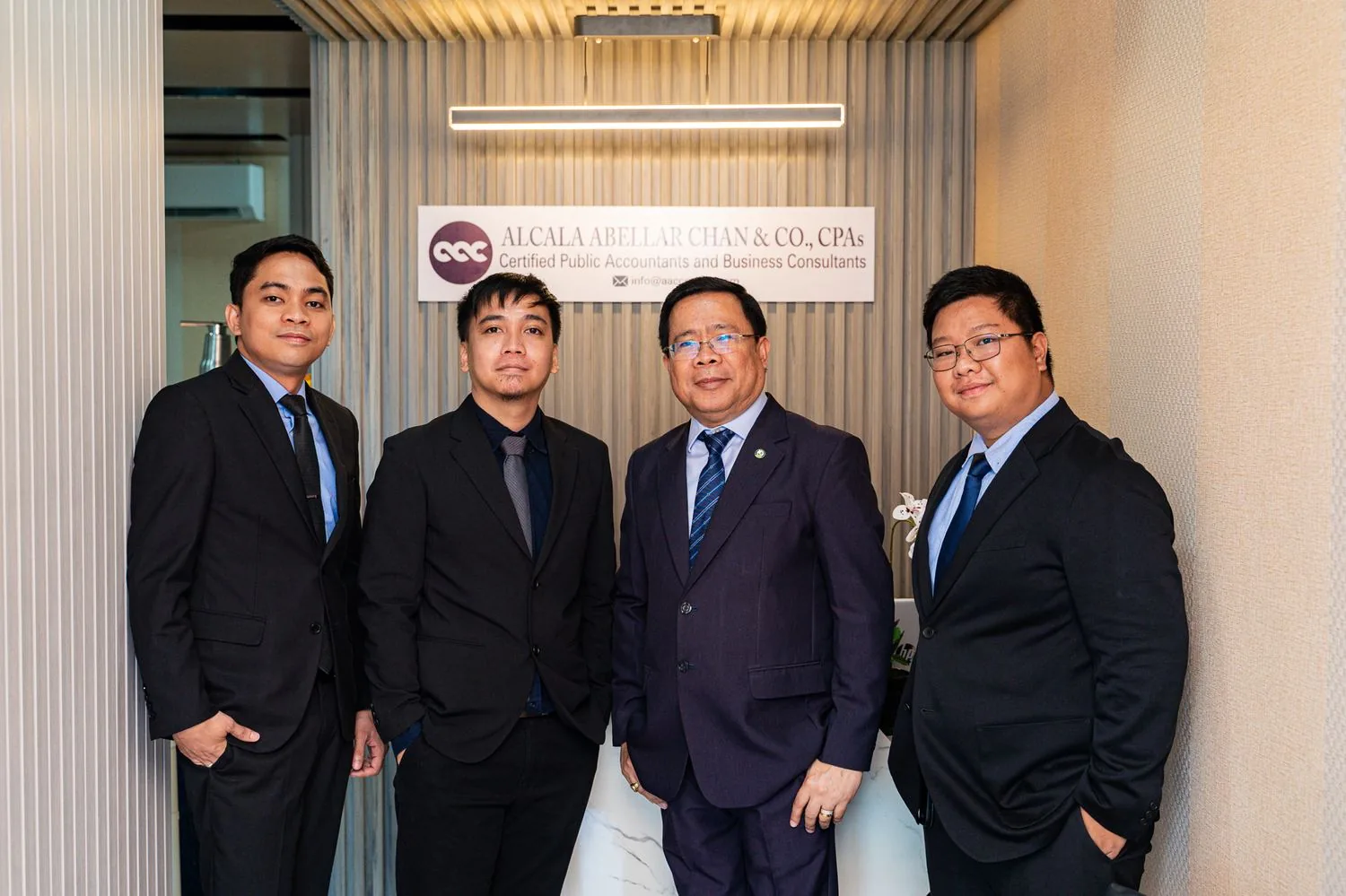

Placed 2nd in the May 2018 CPA licensure examination. Trained in assurance and taxation at one of the largest professional services firms in the world before returning to Region VIII, and has since audited MSMEs through to large corporations. Assists taxpayers through BIR audits and assessments. Teaches audit, assurance, and taxation, and authored a CPA reviewer book on auditing.
View full profile →
Audit and Professional Practice Director at one of the world’s Top 4 professional services firms, serving in its London, New York, and Philippine offices. Sat three consecutive terms on the Audit and Assurance Standards Council, served as National President of PICPA for FY 22-23, and sits on the council of the ASEAN Federation of Accountants. Led Saint Paul School of Professional Studies as President for more than a decade.
View full profile →
Placed 1st in the May 2018 CPA licensure examination and 10th in the December 2023 Bar. Practice centres on tax compliance and health checks, assistance with tax audits, corporate structuring, and tariff and customs compliance. Began his career as a risk and compliance officer, internal auditor, and data privacy officer. Lectures on taxation and commercial law and reviews for the CPA board examinations.
View full profile →
More than half a decade in the public practice of accountancy, auditing MSMEs and large corporations across retail and trade, educational institutions, non-profits, importation, and services. Began as an audit associate at a Manila firm. Works in full-cycle accounting and financial reporting with variance and ratio analysis. School accountant and part-time lecturer at SPSPS, and treasurer of PICPA–Tacloban Chapter.
View full profile →Insights
What falls due this month.
The next filing and payment deadlines we are tracking. Open the calendar for the full year.
Get in touch
Let’s talk about your business.
Tell us what you need — audit, tax, bookkeeping, or advisory — and our team will get back to you.
2nd Floor, Rubber Tree Building, Brgy. 77, 611 BLISS – Fatima Diversion Road, Tacloban City, Philippines 6500
Suite 302, F. Mendoza Complex, Sto. Niño St., Brgy. 28, Tacloban City 6500
0995 398 9482
info@aaccocpas.com
Message us on Messenger
Insights
AAC Tax Code.
The National Internal Revenue Code of 1997 as it currently stands — consolidated by the firm to carry the TRAIN Law, the CREATE Act, the Ease of Paying Taxes Act, the VAT on Digital Services Act, CREATE MORE, the CMEPA and the amendatory laws in force to 1 August 2026, with a footnote at every provision naming the law that changed it.
The printed edition runs to 240 pages and carries the same text, footnotes and references as the browser below. Every section here shows the page it sits on in that PDF, so a citation taken from the screen matches the one taken from the book.
TITLE VI — EXCISE TAXES ON CERTAIN GOODS › CHAPTER VI. EXCISE TAX ON MISCELLANEOUS ARTICLES
SEC. 150-B. Sweetened Beverages
(A) Rate and Base of Tax. — Effective January 1, 2018:
(1) A tax of Six pesos (P6.00) per liter of volume capacity shall be levied, assessed, and collected on sweetened beverages using purely caloric sweeteners, and purely non-caloric sweeteners, or a mix of caloric and non-caloric sweeteners: Provided, That this tax rate shall not apply to sweetened beverages using high fructose corn syrup: Provided, further, That sweetened beverages using purely coconut sap sugar and purely steviol glycosides shall be exempt from this tax; and
(2) A tax of Twelve pesos (P12.00) per liter of volume capacity shall be levied, assessed, and collected on sweetened beverages using purely high fructose corn syrup or in combination with any caloric or non-caloric sweetener.
(B) Definition of Terms. — As used in this Act:
(1) Sweetened beverages (SBs) refer to non-alcoholic beverages of any constitution (liquid, powder, or concentrates) that are pre-packaged and sealed in accordance with the Food and Drug Administration (FDA) standards, that contain caloric and/or non-caloric sweeteners added by the manufacturers, and shall include, but not be limited to the following, as described in the Food Category System from Codex Alimentarius Food Category Descriptors (Codex Stan 192-1995, Rev. 2017 or the latest) as adopted by the FDA:
(i) Sweetened juice drinks;
(ii) Sweetened tea;
(iii) All carbonated beverages;
(iv) Flavored water;
(v) Energy and sports drinks;
(vi) Other powdered drinks not classified as milk, juice, tea, and coffee;
(vii) Cereal and grain beverages; and
(viii) Other non-alcoholic beverages that contain added sugar.
(2) Caloric sweetener refers to a substance that is sweet and includes sucrose, fructose, and glucose that produces a certain sweetness;
(3) High fructose corn syrup refers to a sweet saccharide mixture containing fructose and glucose which is derived from corn and added to provide sweetness to beverages, and which includes other similar fructose syrup preparations; and
(4) Non-caloric sweetener refers to a substance that is [sic] artificially or chemically processed that produces a certain sweetness. These are substances which can be directly added to beverages, such as aspartame, sucralose, saccharin, acesulfame potassium, neotame, cyclamates and other non-nutritive sweeteners approved by the Codex Alimentarius and adopted by the FDA.
(C) Exclusions. — The following products, as described in the food category system from Codex Alimentarius Food Category Descriptors (Codex Stan 192-1995, Rev. 2017 or the latest) as adopted by the FDA, are excluded from the scope of this Act:
(1) All milk products, including plain milk, infant formula milk, follow-on milk, growing up milk, powdered milk, ready-to-drink milk and flavored milk, fermented milk, soymilk, and flavored soymilk;
(2) One Hundred Percent (100%) Natural Fruit Juices — Original liquid resulting from the pressing of fruit, the liquid resulting from the reconstitution of natural fruit juice concentrate, or the liquid resulting from the restoration of water to dehydrated natural fruit juice that do not have added sugar or caloric sweetener;
(3) One Hundred Percent (100%) Natural Vegetable Juices — Original liquid resulting from the pressing of vegetables, the liquid resulting from the reconstitution of natural vegetable juice concentrate, or the liquid resulting from the restoration of water to dehydrated natural vegetable juice that do not have added sugar or caloric sweetener;
(4) Meal Replacement and Medically Indicated Beverages — Any liquid or powder drink/product for oral nutritional therapy for persons who cannot absorb or metabolize dietary nutrients from food or beverages, or as a source of necessary nutrition used due to a medical condition and an oral electrolyte solution for infants and children formulated to prevent dehydration due to illness; and
(5) Ground coffee, instant soluble coffee, and pre-packaged powdered coffee products.
(D) Filing of Return and Payment of Excise Tax and Penalty. —
(1) Filing of Return and Payment of Excise Tax on Domestic and Imported Sweetened Beverages. — The provision of Sections 130 and 131 of the NIRC, as appropriate, shall apply to sweetened beverages.
(2) Penalty. — Upon final findings by the Commissioner of Internal Revenue and/or Customs that any manufacturer or importer, in violation of this Section, misdeclares or misrepresents in the sworn statement provided in Section 130(c) of the NIRC, as amended, any pertinent data or information, the penalty of summary cancellation or withdrawal of the permit to engage in business as manufacturer or importer of sweetened beverages as provided under Section 268 of the NIRC, as amended, shall be imposed.
Any corporation, association or partnership liable for any of the acts or omissions in violation of this Section shall be fined treble the amount of deficiency taxes, surcharges, and interest which may be assessed pursuant to this Section.
Any person liable for any of the acts or omissions prohibited under this Section shall be criminally liable and penalized under Section 254 of the NIRC, as amended. Any person who willfully aids or abets in the commission of any such act or omission shall be criminally liable in the same manner as the principal.
If not a citizen of the Philippines, the offender shall be deported immediately after serving the sentence without further proceedings for deportation.
(E) Specific Responsibility of the Food and Drug Administration (FDA). — Starting June 1, 2018, the FDA shall require all manufacturers and importers of sweetened beverages covered by this Act to indicate on the label the type of sweetener used, and on sweetened beverages in powder form to indicate on the label the equivalent of each serving per liter of volume capacity.
The FDA shall also conduct post-marketing surveillance of the sweetened beverages on display in supermarkets, groceries or retail stores and/or inspection of manufacturing sites to determine compliance with the requirements of this Section. Violations of the provisions of this Act, including but not limited to, mislabeling or misbranding, shall, to the extent applicable, be punishable under existing laws.
(F) Duty of the Commissioner to Ensure Payment of Taxes. — It shall be the duty of the Commissioner, among other things, to prescribe a materially unique, secure and nonremovable identification, such as codes, stamps or other markings, to be firmly and conspicuously affixed on and form part of the label of all excisable sweetened beverages.
For this purpose, the abovementioned control measure shall be caused by the Commissioner to be printed with adequate security features to ensure the payment of excise tax on sweetened beverages.
(G) Review of Implementation of the Sweetened Beverage Tax. — At the start of the implementation of the sugar sweetened beverage tax and every year thereafter, the Department of Health, Department of Science and Technology, and Department of Finance shall review the impact of these provisions on its health objectives with the view to making recommendations on the tax rate on these beverages.289
Amendment notes
- TRAIN Law, sec. 47 — inserted.