
What we do
Full-service assurance, tax, and advisory.
From statutory audit to strategic advisory, our engagements are built on rigor, ethics, and a genuine understanding of your business.
Audit & Assurance
- Financial statements audit
- Internal audit
- Review of historical financial statements
- Review of prospective financial statements
Tax Services
- Tax assessment
- Tax compliance health check
- Tax due diligence
- Tax opinions and rulings
- Tax planning and structuring
- Estate and donor’s tax compliance
Accounting Services
- Bookkeeping
- Compilation of financial statements
- Account reconciliations
- Internal accounting
Advisory & Business Consultancy
- Business policy making
- Financial due diligence
- Risk management
- Strategic management
Corporate Services
- Business registration
- Corporate structuring
- Corporate secretarial
- Payroll processing and compliance
Other Services
- Agreed-upon procedures
- Company profiling & loan application assistance
- Estate planning · Retirement planning and funding
- Contract review · Collection services
- Real estate services and other allied services
Who we serve
Industries we serve.
The reporting framework, the controls, and the regulator differ by sector. Our engagements cover twelve.
Beyond Tacloban City
Engagements run from wherever you are.
Clients elsewhere in Eastern Visayas, in Metro Manila and in other regions work with us without travelling to our office.
Documents turned over online
Records, schedules and supporting documents are exchanged through shared online folders, and reports are delivered the same way.
Meetings by video call
Planning, status and closing meetings are held by video call. Visits are scheduled where the work requires them, such as an inventory count.
Electronic filing
Returns and reports are filed through the online systems of the BIR, the SEC and the other agencies that accept them.
Our Partners
Led by credentialed professionals.
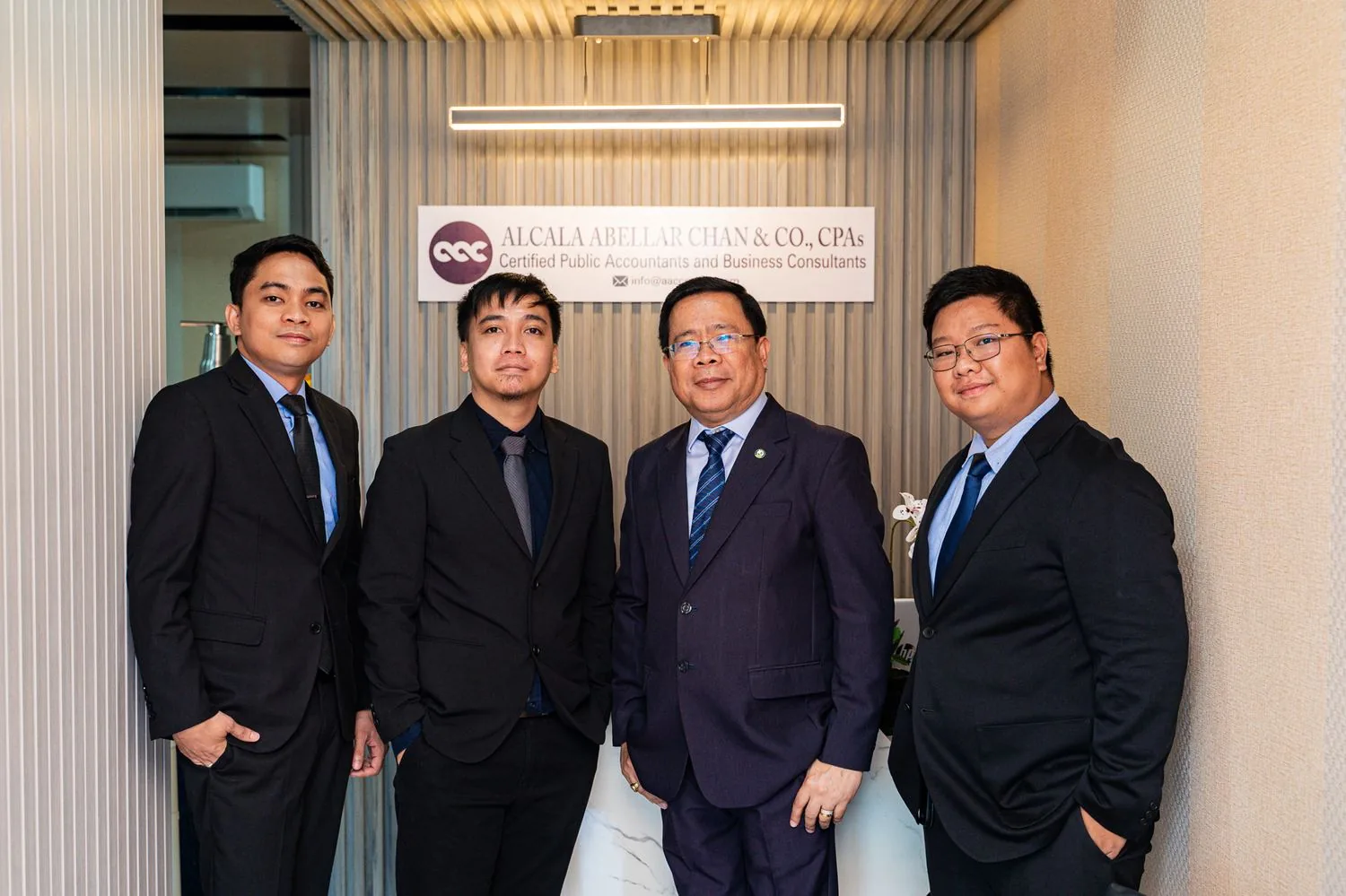
Four partners with national distinctions, international practice, and deep roots in the academe.

Placed 2nd in the May 2018 CPA licensure examination. Trained in assurance and taxation at one of the largest professional services firms in the world before returning to Region VIII, and has since audited MSMEs through to large corporations. Assists taxpayers through BIR audits and assessments. Teaches audit, assurance, and taxation, and authored a CPA reviewer book on auditing.
View full profile →
Audit and Professional Practice Director at one of the world’s Top 4 professional services firms, serving in its London, New York, and Philippine offices. Sat three consecutive terms on the Audit and Assurance Standards Council, served as National President of PICPA for FY 22-23, and sits on the council of the ASEAN Federation of Accountants. Led Saint Paul School of Professional Studies as President for more than a decade.
View full profile →
Placed 1st in the May 2018 CPA licensure examination and 10th in the December 2023 Bar. Practice centres on tax compliance and health checks, assistance with tax audits, corporate structuring, and tariff and customs compliance. Began his career as a risk and compliance officer, internal auditor, and data privacy officer. Lectures on taxation and commercial law and reviews for the CPA board examinations.
View full profile →
More than half a decade in the public practice of accountancy, auditing MSMEs and large corporations across retail and trade, educational institutions, non-profits, importation, and services. Began as an audit associate at a Manila firm. Works in full-cycle accounting and financial reporting with variance and ratio analysis. School accountant and part-time lecturer at SPSPS, and treasurer of PICPA–Tacloban Chapter.
View full profile →Insights
What falls due this month.
The next filing and payment deadlines we are tracking. Open the calendar for the full year.
Get in touch
Let’s talk about your business.
Tell us what you need — audit, tax, bookkeeping, or advisory — and our team will get back to you.
2nd Floor, Rubber Tree Building, Brgy. 77, 611 BLISS – Fatima Diversion Road, Tacloban City, Philippines 6500
Suite 302, F. Mendoza Complex, Sto. Niño St., Brgy. 28, Tacloban City 6500
0995 398 9482
info@aaccocpas.com
Message us on Messenger
Insights
AAC Tax Code.
The National Internal Revenue Code of 1997 as it currently stands — consolidated by the firm to carry the TRAIN Law, the CREATE Act, the Ease of Paying Taxes Act, the VAT on Digital Services Act, CREATE MORE, the CMEPA and the amendatory laws in force to 1 August 2026, with a footnote at every provision naming the law that changed it.
The printed edition runs to 240 pages and carries the same text, footnotes and references as the browser below. Every section here shows the page it sits on in that PDF, so a citation taken from the screen matches the one taken from the book.
TITLE XI — ALLOTMENT OF INTERNAL REVENUE › TAXES
SEC. 288. Disposition of Incremental Revenues
(A) Incremental Revenues from Republic Act No. 7660. — The incremental revenues from the increase in the documentary stamp taxes under R.A. No. 7660 shall be set aside for the following purposes:
(1) In 1994 and 1995, twenty-five percent (25%) thereof respectively, shall accrue to the Unified Home-Lending Program under Executive Order No. 90 particularly for mass-socialized housing program to be allocated as follows: fifty percent (50%) for mass-socialized housing; thirty percent (30%) for the community mortgage program; and twenty percent (20%) for land banking and development to be administered by the National Housing Authority: Provided, That not more than one percent (1%) of the respective allocations hereof shall be used for administrative expenses;
(2) In 1996, twenty-five percent (25%) thereof to be utilized for the National Health Insurance Program that hereafter may be mandated by law;
(3) In 1994 and every year thereafter, twenty-five percent (25%) thereof shall accrue to a Special Education Fund to be administered by the Department of Education, Culture and Sports for the construction and repair of school facilities, training of teachers, and procurement or production of instructional materials and teaching aids; and
(4) In 1994 and every year thereafter, fifty percent (50%) thereof shall accrue to a Special Infrastructure Fund for the construction and repair of roads, bridges, dams and irrigation, seaports and hydroelectric and other indigenous power projects: Provided, however, That for the years 1994 and 1995, thirty percent (30%), and for the years 1996, 1997 and 1998, twenty percent (20%), of this fund shall be allocated for depressed provinces as declared by the President as of the time of the effectivity of R.A. No. 7660: Provided, further, That availments under this fund shall be determined by the President on the basis of equity.
Provided, finally, That in paragraphs (2), (3) and (4) of this Section, not more than one percent (1%) of the allocated funds thereof shall be used for administrative expenses by the implementing agencies.
[(B) Incremental Revenues from Republic Act No. 8240.]403
[(C) Incremental Revenues from the Excise Tax on Alcohol and Tobacco Products.]404
(D) Incremental Revenue from the Value-added Tax. — Fifty percent (50%) of the local government unit’s share from the incremental revenue from the value-added tax shall be allocated and used exclusively for the following purposes:
(1) Fifteen percent (15%) for public elementary and secondary education, to finance the construction of buildings, purchases of school furniture and in-service teacher trainings;
(2) Ten percent (10%) for health insurance premiums of enrolled indigents as a counterpart contribution of the local government to sustain the universal coverage of the national health insurance program;
(3) Fifteen percent (15%) for environmental conservation to fully implement a comprehensive national reforestation program; and
(4) Ten percent (10%) for agricultural modernization to finance the construction of farm-to-market roads and irrigation facilities.
Such allocations shall be segregated as separate trust funds by the national treasury and shall be over and above the annual appropriation for similar purposes.
(E) The amount of Fifteen million pesos (P15,000,000) shall be allocated for a Public Information and Education Program to be administered by the Bureau of Internal Revenue, explaining clearly to businesses their registration, invoicing and reporting requirements under the value-added tax rules. Such program should include seminars and visits to taxpayers to familiarize them with the tax, and the development and publication of easy-to-read guides on the value-added tax.
(F) Incremental Revenues from the Tax Reform for Acceleration and Inclusion (TRAIN). — For five (5) years from the effectivity of this Act, the yearly incremental revenues generated shall be automatically appropriated as follows:
(1) Not more than seventy percent (70%) to fund infrastructure projects such as, but not limited to, the Build, Build, Build Program and provide infrastructure programs to address congestion through mass transport and new road networks, military infrastructure, sports facilities for public schools, and potable drinking water supply in all public places; and
(2) Not more than thirty percent (30%) to fund:
(a) Programs under Republic Act No. 10659, otherwise known as ‘Sugarcane Industry Development Act of 2015,’ to advance the self-reliance of sugar farmers that will increase productivity, provide livelihood opportunities, develop alternative farming systems and ultimately enhance farmers’ income;
(b) Social mitigating measures and investments in: (i) education, (ii) health, targeted nutrition, and anti-hunger programs for mothers, infants, and young children, (iii) social protection, (iv) employment, and (v) housing that prioritize and directly benefit both the poor and near-poor households;
(c) A social welfare and benefits program where qualified beneficiaries shall be provided with a social benefits card to avail of the following social benefits:
(i) Unconditional cash transfer to households in the first to seventh income deciles of the National Household Targeting System for Poverty Reduction (NHTS-PR), Pantawid Pamilyang Pilipino Program, and the social pension program for a period of three (3) years from the effectivity of this Act: Provided, That the unconditional cash transfer shall be Two hundred pesos (P200.00) per month for the first year and
Three hundred pesos (P300.00) per month for the second year and third year, to be implemented by the Department of Social Welfare and Development (DSWD);
(ii) Fuel vouchers to qualified franchise holders of Public Utility Jeepneys (PUJs);
(iii) For minimum wage earners, unemployed, and the poorest fifty percent (50%) of the population:
(1) Fare discount from all public utility vehicles (except trucks for hire and school transport service) in the amount equivalent to ten percent (10%) of the authorized fare;
(2) Discounted purchase of National Food Authority (NFA) rice from accredited retail stores in the amount equivalent to ten percent (10%) of the net retail prices, up to a maximum of twenty (20) kilos per month; and
(3) Free skills training under a program implemented by the Technical Skills and Development Authority (TESDA).
Provided, That benefits or grants contained in this Subsection shall not be availed in addition to any other discounts.
(iv) Other social benefits programs to be developed and implemented by the government.
An interagency committee, chaired by the Department of Budget and Management (DBM) and co-chaired by DOF and DSWD, and comprised of the National Economic and Development Authority (NEDA), Department of Transportation (DOTr), Department of Education (DepEd), Department of Health (DOH), Department of Labor and Employment (DOLE), National Housing Authority (NHA), Sugar Regulatory Administration (SRA), Department of the Interior and Local Government (DILG), Department of Energy (DOE), NFA, and TESDA, is hereby created to oversee the identification of qualified beneficiaries and the implementation of these projects and programs: Provided, That qualified beneficiaries under Subsection (c) hereof shall be identified using the National ID System which may be enacted by Congress.
Within sixty (60) days from the end of the three (3)-year period from the effectivity of this Act, the interagency committee and respective implementing agencies for the above programs shall submit corresponding program assessments to the COCCTRP. The National Expenditure Program from 2019 onwards shall provide line items that correspond to the allocations mandated in the provisions above.
At the end of five (5) years from the effectivity of this Act, all earmarking provisions under Subsection (F), shall cease to exist and all incremental revenues derived under this Act shall accrue to the General Fund of the government.405
(H) Incremental Revenues from Value-added Tax on Digital Service Providers. — Five percent (5%) of the incremental revenue from the value-added tax on digital service providers under Section 108 shall be allotted to and used exclusively for the development of creative industries, as defined under Republic Act No. 11904, otherwise known as the “Philippine Creative Industries Development Act, ” for five (5) years from the effectivity of Republic Act No. 12023.406
Upon the lapse of the five (5)-year period, all such incremental revenues shall accrue to the General Fund.
Amendment notes
- Subsection (G), earmarking sixty percent (60%) of the revenue collected under the offshore gaming regime, was introduced by sec. 9 of Republic Act No. 11590, approved 22 September 2021. Republic Act No. 11590 was repealed in its entirety by sec. 18 of Republic Act No. 12312, the Anti-POGO Act of 2025, approved 23 October 2025, which bans and criminalises offshore gaming operations. The amendments it introduced are accordingly spent. Republic Act No. 12312 contains no clause reviving the text that preceded them.
- RA 11346, sec. 15 — repealed.
- RA 11346, sec. 15 — repealed.
- TRAIN Law, sec. 82 — inserted.
- RA 12023, sec. 12 — inserted.